Depression has a way of draining the color out of everything. You might be wondering if there’s a therapy that gives you real tools to work with.
DBT for depression is a structured, skills-based therapy that gives you practical tools for managing the intense emotions, negative thought patterns, and isolation that come with depression. You’ll learn skills you can use right now.
Here’s what DBT is, how it helps with depression, the four core skills that matter, and exercises you can try today.

What Is DBT for Depression?
Dialectical Behavior Therapy (DBT) was developed by Dr. Marsha Linehan in the late 1980s. Originally designed for borderline personality disorder, researchers found its skills are also effective for depression, anxiety, and other mental health challenges.
DBT for depression is a structured therapy that teaches practical skills for managing emotions, handling distress, and building healthier relationships. It combines acceptance strategies with behavior change techniques to help you break free from depression’s grip.
What makes DBT different is its core idea: you can accept yourself as you are right now and work toward change at the same time. That’s the “dialectic” part.
If you’d like to learn more about how we approach this therapy, you can learn more about how Abalance Counseling approaches DBT.
How Is DBT Different from Traditional Talk Therapy?
Traditional talk therapy focuses on exploring past experiences and understanding your feelings. DBT is more action-oriented: you learn specific skills, practice them between sessions, and bring your experience back to discuss.
Think of it like physical therapy for your emotions. You get homework, use a diary card to track progress, and build new habits one skill at a time. DBT is structured and time-limited, typically running several months.
The Science Behind DBT and Depression
DBT isn’t just a good idea. It’s backed by research. Multiple randomized controlled trials (RCTs) have shown that DBT reduces depressive symptoms in adults with major depressive disorder (MDD).
A 2024 study found that DBT skills training was effective for treating MDD with non-suicidal self-injury (PubMed). Research also supports DBT for reducing self-harm and suicide attempts in highly suicidal adolescents (McCauley et al., 2018).
Here’s why DBT works for depression: it teaches emotional regulation, which counters depression’s hallmark symptoms: low mood, hopelessness, and loss of interest. Research also suggests DBT can change brain activity patterns related to emotional reactivity.
DBT has shown effectiveness across age groups, from adolescents to older adults. According to the National Institute of Mental Health (NIMH), an estimated 21.0 million adults in the United States had at least one major depressive episode in 2021, affecting about 8.3% of all U.S. adults.

The 4 Core DBT Skills for Managing Depression
DBT teaches four core skill modules that address how depression affects your thoughts, emotions, reactions, and relationships.
Here are the four core DBT skills for depression:
- Mindfulness: staying present when depression pulls you away
- Distress Tolerance: getting through the hardest moments
- Emotional Regulation: understanding and managing your feelings
- Interpersonal Effectiveness: rebuilding connection with others
Let’s look at each one in more detail.
Mindfulness: Staying Present When Depression Pulls You Away
Depression has a sneaky habit of pulling you out of the present moment. You might find yourself stuck in the past, replaying mistakes and regrets, or worrying about a future that feels hopeless and empty.
Mindfulness skills help you anchor in the here and now. In DBT, mindfulness includes “what” skills (observe, describe, participate) and “how” skills (non-judgmentally, one-mindfully, effectively).
A quick exercise to try: the 5-4-3-2-1 grounding technique. Notice five things you can see, four things you can touch, three things you can hear, two things you can smell, and one thing you can taste. This pulls your attention away from the spiral of negative thoughts and back into the real world around you.
Mindfulness for depression helps break the cycle of rumination, which is one of the biggest drivers of staying stuck in a low mood.
Distress Tolerance: Getting Through the Hardest Moments
Depression can bring moments of overwhelming pain. Distress tolerance skills help you survive those moments without making things worse.
One of the most powerful distress tolerance tools is the STOP Skill:
- Stop: freeze, don’t react immediately
- Take a step back: breathe, give yourself space
- Observe: notice what’s happening inside you and around you
- Proceed mindfully: act with awareness, not impulse
There’s also the TIP Skill for reducing emotional arousal fast: splash cold water on your face, do intense exercise, practice paced breathing, or use paired muscle relaxation. These techniques work with your body’s nervous system to bring your emotional intensity down quickly.
Another important distress tolerance concept is radical acceptance: accepting reality as it is, not as you want it to be. This doesn’t mean you like what’s happening. It means you stop fighting against what you can’t change, which reduces suffering.
Emotional Regulation: Understanding and Managing Your Feelings
Depression messes with your emotional thermostat. Some days you feel nothing at all, numb and disconnected. Other days you feel everything at once, overwhelmed by sadness, irritability, or anxiety. Emotional regulation skills help you find a middle ground.
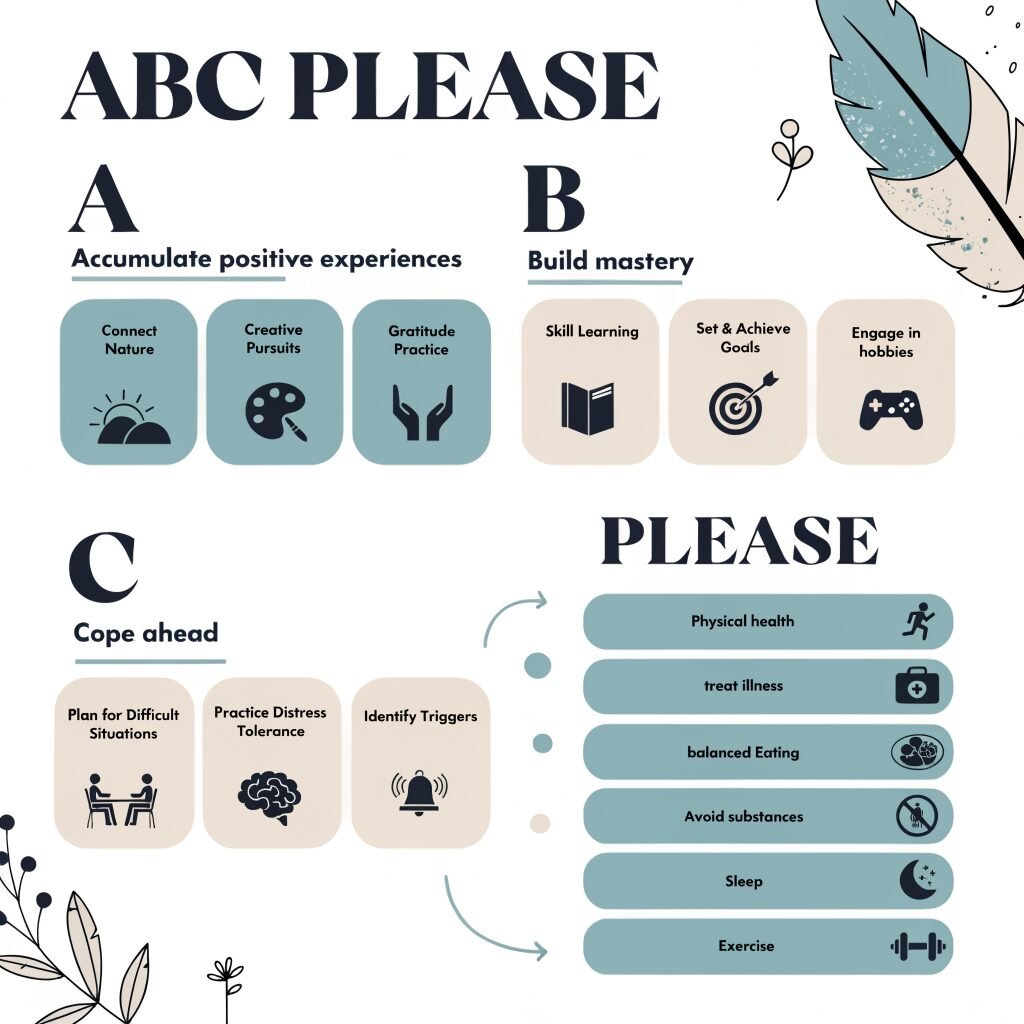
A key DBT emotional regulation tool is the ABC PLEASE skill:
- Accumulate positive experiences: do things that bring small moments of joy
- Build mastery: do one thing each day that makes you feel competent
- Cope ahead: prepare for difficult situations in advance
- Physical illness treatment: take care of your body
- Lack of sleep: prioritize rest
- Eating: nourish yourself regularly
- Avoid mood-altering substances
- Stay balanced: exercise regularly
Another useful practice is checking the facts: ask yourself whether your emotional response matches the situation. Depression often amplifies everything, making small setbacks feel catastrophic.
Interpersonal Effectiveness: Rebuilding Connection
Depression makes you want to isolate, but connection is crucial for recovery. Interpersonal effectiveness skills help you ask for what you need and set healthy boundaries.
The DEAR MAN technique helps you communicate effectively:
- Describe the situation
- Express your feelings
- Assert what you need
- Reinforce by explaining the positive outcome
- Mindful: stay focused on what you need
- Appear confident, even if you don’t feel it
- Negotiate: be willing to give and take
You can use these skills to tell a loved one, “I’m struggling right now and I need help.” Rebuilding relationships counters the isolation that depression thrives on.
DBT vs. CBT for Depression: What’s the Difference?
If you’ve been researching therapy options, you’ve likely come across both DBT and CBT (Cognitive Behavioral Therapy). Here’s how they compare:
| Aspect | DBT | CBT |
|---|---|---|
| Core Focus | Accepting emotions while changing behaviors | Changing negative thought patterns |
| Best For | Intense emotions, self-harm, relationship struggles, treatment-resistant depression | Mild to moderate depression, anxiety, specific thought patterns |
| Key Skills | Mindfulness, distress tolerance, emotional regulation, interpersonal effectiveness | Cognitive restructuring, behavioral activation, thought records |
| Structure | Skills training + individual therapy + phone coaching | Usually individual therapy with homework |
| Philosophy | “You are doing the best you can, AND you can do better” | “Your thoughts create your feelings. Change the thoughts, change the feelings.” |
DBT may be helpful if you’ve tried CBT and still struggle, or if your depression involves intense emotions, self-harm urges, or relationship difficulties. Both approaches are used at Abalance Counseling, and your therapist can help you decide which fits your needs.
Want to learn more about the CBT approach? Check out our beginner’s guide to CBT.
What to Expect When Starting DBT for Depression
Starting any new therapy can feel overwhelming. Here’s what to expect.
DBT typically involves weekly individual therapy sessions. In comprehensive programs, you also attend a skills training group where you practice the four core skills alongside others. You’ll track your emotions and skills use with a diary card to help you and your therapist see patterns.
DBT is active therapy. You’ll practice skills between sessions and bring your experience back to discuss. Progress isn’t linear. Some weeks will feel harder than others, and that’s completely normal.
How Long Does DBT Take to Work?
Standard comprehensive DBT usually lasts 6 to 12 months. But many people notice improvements in specific skills within just a few weeks. Shorter DBT-informed programs can run 12 to 16 weeks.
Skill improvement is cumulative. The more you practice, the more natural these tools become.
Practical DBT Exercises You Can Try Today
You don’t have to wait for your first session to start using DBT skills. Try these three exercises.
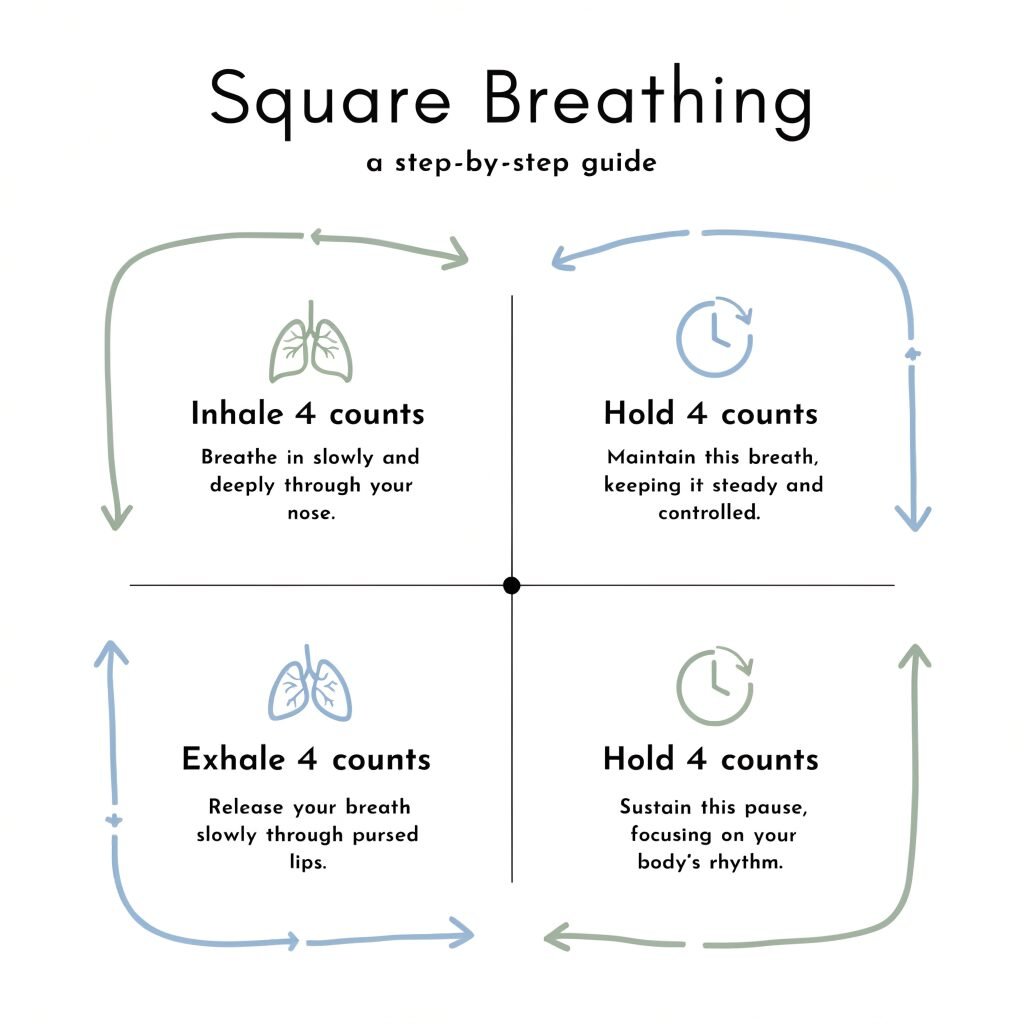
Exercise 1: Square Breathing (Distress Tolerance)
One of the simplest tools for when you feel overwhelmed:
- Breathe in for 4 counts
- Hold for 4 counts
- Breathe out for 4 counts
- Hold for 4 counts
- Repeat 4 to 5 times
Use this when depression’s weight feels crushing. The rhythmic breathing calms your body’s stress response.
Exercise 2: The STOP Skill in Action
You wake up feeling hopeless and want to cancel everything. Here’s how the STOP skill works:
- Stop. Don’t cancel yet. Just pause.
- Take a breath. Step back from the feeling for a moment.
- Observe. “I’m feeling hopeless. That’s depression talking. It will pass.”
- Proceed. What’s one small thing you can do today? Take a shower. Eat breakfast. Step outside for five minutes.
The goal isn’t to pretend you feel fine. It’s to give yourself space before making decisions based on how you feel right now.
Exercise 3: Build Your Mastery Menu (Emotional Regulation)
This exercise helps you prove to yourself that you’re capable, even when depression tells you otherwise.
- List 3 to 5 small things you can do that make you feel capable. Examples: make your bed, fold laundry, cook one meal, do five minutes of stretching, water a plant.
- Each day, pick ONE item from your mastery menu.
- The goal isn’t to be productive. It’s to prove to yourself that you can do things.
Start small. Even making your bed counts. Over time, these tiny accomplishments build momentum.

How Abalance Counseling Approaches DBT for Depression
At Abalance Counseling, we believe therapy should fit your life, not the other way around. Our therapists are trained in DBT and understand the weight of depression.
Here’s what makes our approach different:
- Personalized treatment plans tailored to your specific needs and goals
- A client-first philosophy: you’re not a diagnosis, you’re a person
- Flexible options: we offer both in-person and teletherapy appointments
- Located in the Central Valley and Coastal Region of California, serving communities that deserve access to quality mental health care
You can explore our DBT services or reach out to schedule an appointment. We’re here when you’re ready.
Depression: You’re Not Alone in This
If you’re struggling with depression, please know this: you are not alone, and you are not broken.
According to the National Institute of Mental Health, an estimated 21.0 million U.S. adults had at least one major depressive episode in 2021, with young adults aged 18 to 25 most affected at 18.6%.
The good news: nearly 61% of adults with depression received treatment. That means millions of people are getting help and feeling better. You can too.
If you’re experiencing depression, learn more about how we treat depression at Abalance Counseling. If you’re experiencing thoughts of self-harm, you’re not alone — learn more about suicidal ideation and how to get help. You can also reach out to the SAMHSA National Helpline or call the 988 Suicide and Crisis Lifeline.
Frequently Asked Questions About DBT for Depression
What is DBT for depression?
DBT for depression is a structured therapy that teaches practical skills to manage the intense emotions, negative thought patterns, and behavioral challenges that come with depression. It combines mindfulness, distress tolerance, emotional regulation, and interpersonal effectiveness.
How does DBT help with depression?
DBT helps by teaching specific skills: mindfulness to break rumination, distress tolerance to survive hard moments, emotional regulation to manage mood, and interpersonal effectiveness to rebuild connections.
What are the 4 DBT skills for depression?
The four core DBT skills are: (1) Mindfulness, staying present; (2) Distress Tolerance, surviving crises; (3) Emotional Regulation, managing feelings; and (4) Interpersonal Effectiveness, improving relationships.
Is DBT or CBT better for depression?
Both are effective but work differently. CBT focuses on changing negative thought patterns and works well for mild to moderate depression. DBT emphasizes accepting emotions while building coping skills and may be better for intense emotions or treatment-resistant depression.
How long does DBT take to work for depression?
Comprehensive DBT typically lasts 6 to 12 months, though many people notice improvements within weeks. Shorter programs can run 12 to 16 weeks.
Taking the Next Step: Finding Support That Fits You
DBT offers real, practical skills that help you manage depression day by day. You don’t have to figure this out alone.
At Abalance Counseling, we’re here to help when you’re ready.
Schedule an appointment or call us at (209) 262-4387. You can also meet our team and learn more about who we are.
You’re not broken. You’re dealing with something incredibly hard, and you’re still here. That matters more than you know.