
If you have been through a traumatic experience, you may have noticed that certain thoughts keep replaying in your mind. Thoughts like “It was my fault” or “I can never feel safe again” can feel absolutely true, even when they are not helping you heal. In Cognitive Processing Therapy (CPT), these repeating, unhelpful thoughts are called stuck points.
Stuck points are one of the biggest reasons people struggle to recover from trauma. The good news is that once you understand what they are and how they work, you can begin to challenge them.

What Are Stuck Points in CPT?
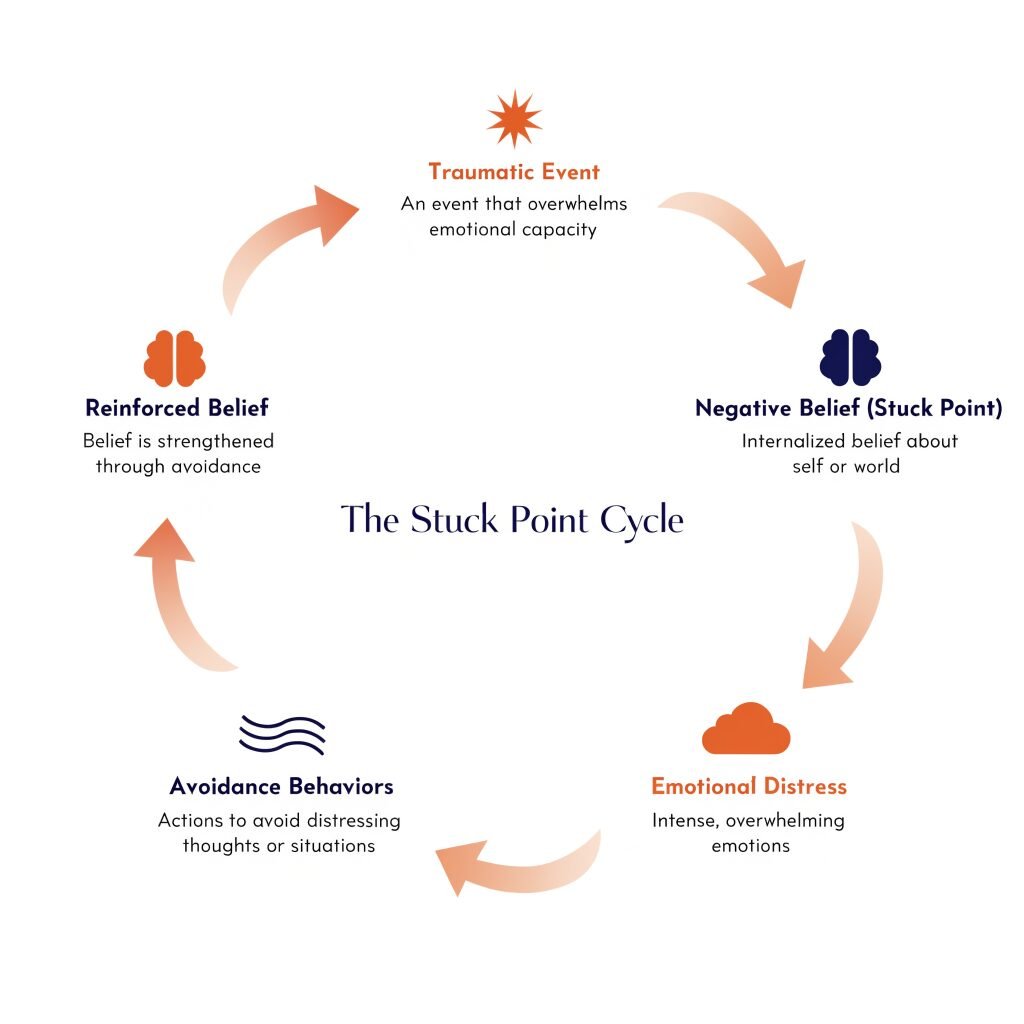
A stuck point is a thought or belief that keeps you “stuck” in your recovery after a traumatic event. According to the U.S. Department of Veterans Affairs, stuck points are thoughts that are “less than 100% accurate” and prevent you from moving forward. Unlike everyday negative thoughts, which tend to fade, stuck points are persistent and apply broadly to your life. A belief like “Nowhere is safe” makes you scan for threats, and the symptoms confirm the belief.
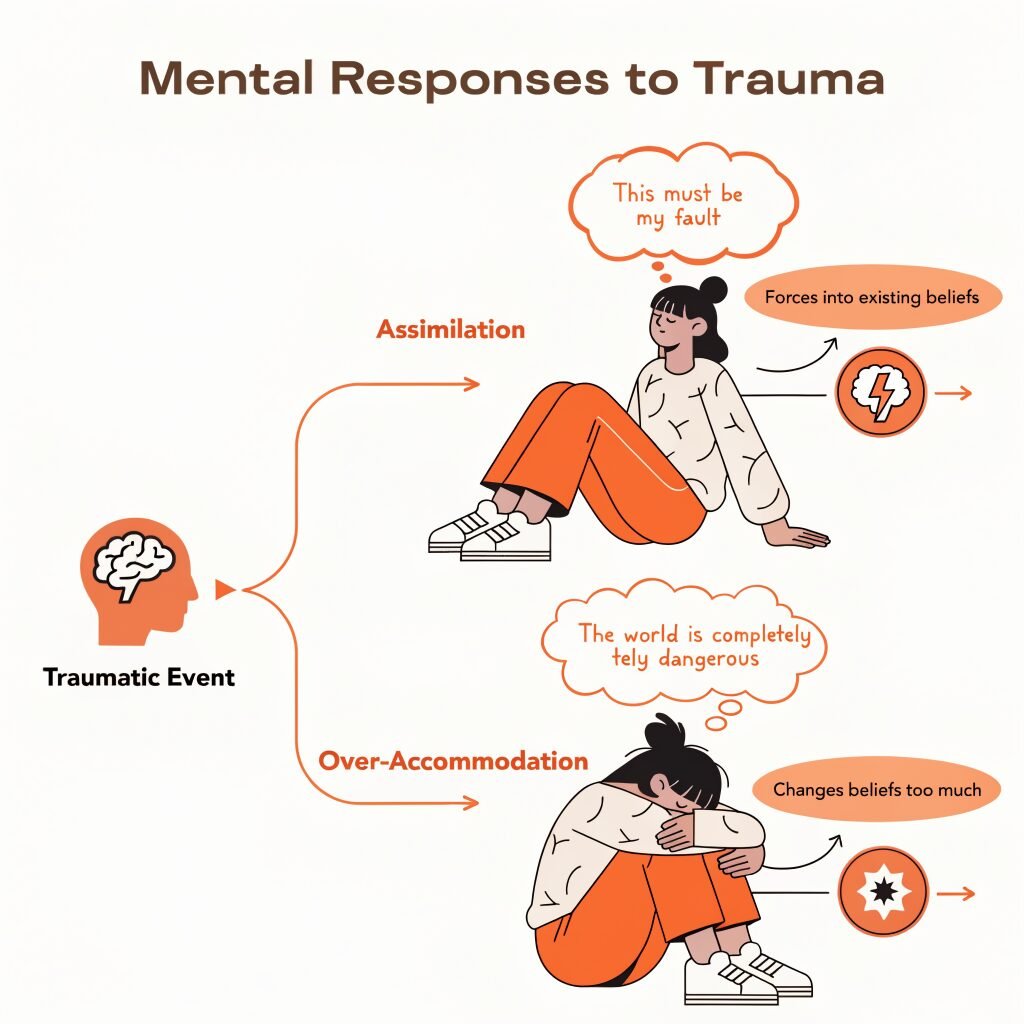
Stuck points form through two cognitive processes: assimilation, altering trauma information to fit existing beliefs, and over-accommodation, forming overly generalized beliefs. Both trap you in thought patterns that maintain PTSD symptoms.
Why Do Stuck Points Form After Trauma?
When something traumatic happens, your brain tries to make sense of it. This is a natural response. Sometimes, the conclusions it reaches are not accurate, but they feel true because they formed during a moment of intense fear, pain, or confusion.
As the Complex PTSD Foundation explains, “The ‘stickiness’ of a stuck point often reflects the magnitude of the hurt that shaped it. This rigidity is not a personal failing; it is the mind’s protective architecture at work.” Stuck points are your brain’s way of trying to protect you. The problem is that what once helped you survive a difficult moment now keeps you from living fully.
Common factors that make stuck points form include self-blame, shame and guilt, a loss of control, and broken trust. When these feelings harden into beliefs, they can become extremely difficult to shift without support.
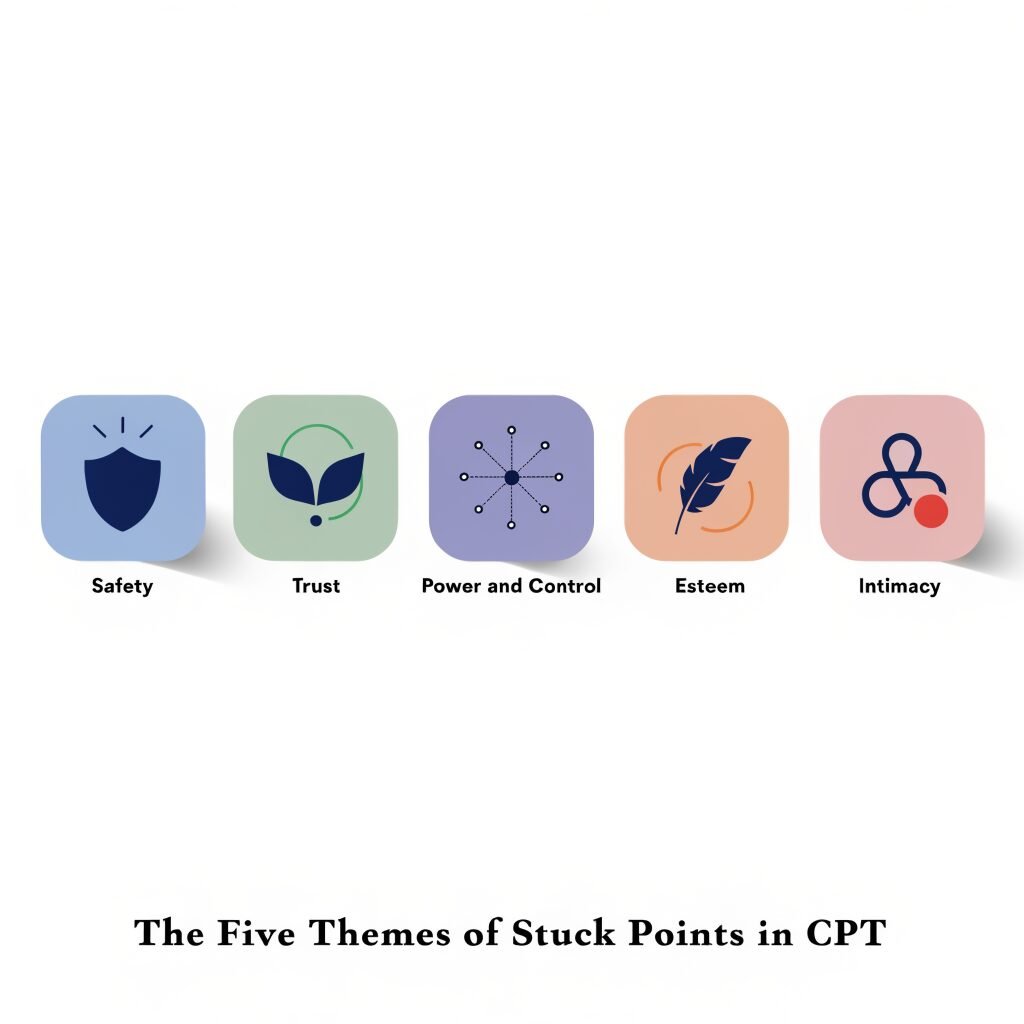
The Five Themes of Stuck Points
CPT organizes stuck points into five core themes, each representing an area of your life that trauma commonly disrupts:
1. Safety
Stuck points about safety involve beliefs that the world is dangerous and you can never be protected. Examples: “Nowhere is safe anymore” and “I can’t protect myself or my loved ones.”
2. Trust
Trauma can shake your ability to trust others or yourself. Examples: “No one can be trusted” and “If I let people get close, I will get hurt.”
3. Power and Control
When trauma takes away your sense of control, you may develop beliefs like “I have no power over my own life” or “I must control everything to stay safe.”
4. Esteem
Stuck points about esteem show up as beliefs about your own worth, like “I am damaged” or “I am worthless because I couldn’t control what happened.”
5. Intimacy
Trauma can make closeness with others feel dangerous. Examples: “I can never truly connect with anyone again” and “If I let someone close, they will eventually hurt me.”
Common Stuck Point Examples
Stuck points follow recognizable patterns. Common examples include self-blame thoughts like “It was my fault” and “I should have fought back,” safety and trust beliefs like “The world is dangerous and I can never feel safe again” and “I can’t trust anyone,” and esteem-related stuck points like “I am permanently damaged” and “Things will never get better.”
Notice that these are not feelings or events. They are thoughts, specifically beliefs you hold about yourself, others, or the world. A key part of CPT is learning to identify these beliefs so they can be examined and challenged.
How to Identify Your Own Stuck Points
Identifying stuck points is the first step in CPT, and you can start practicing on your own:
Pay Attention to “Always” and “Never” Thinking
Stuck points often contain absolute language. Words like “always,” “never,” “everyone,” and “no one” are red flags. When you catch yourself thinking in absolutes, it may be a stuck point worth examining.
Use the ABC Worksheet
One practical tool for identifying stuck points is the ABC Worksheet, which is used in CPT. It works like this:
- A (Activating Event): What happened? Write down the situation.
- B (Beliefs): What did you tell yourself about the event? This is where the stuck point lives.
- C (Consequences): What emotions and behaviors resulted from that belief?
For example, a friend does not respond to your text for three days. Your belief: “She has realized I am not worth her time. Everyone leaves eventually.” The consequence: you feel worthless and stop reaching out. The stuck point is “Everyone leaves eventually,” a broad generalization based on past experience.
Look for the “If-Then” Pattern
Many stuck points can be formatted as “If-Then” statements. For example: “If I let others get close, then I will get hurt.” Or: “If I had done my job better, then other people would have survived.” This structure can help you pinpoint the exact belief that is keeping you stuck.
Why Stuck Points Are Hard to Overcome
You might wonder: if stuck points are distorted thoughts, why can’t you just think your way out of them? The reason is that stuck points are not experienced as distortions. They are experienced as insights. They feel like facts, not opinions. As research on CPT explains, stuck points that feel most factually “true” to a trauma survivor are often the ones causing the most psychological harm.
Stuck points persist because they form during intense emotions, create confirmation bias (your brain looks for evidence that supports the belief), can feel like loyalty to the trauma, and offer a false sense of safety. Understanding why they are hard to change is not about making excuses. It is about giving yourself compassion as you work to examine your beliefs and find more balanced ways of thinking.
How CPT Helps You Challenge Stuck Points
Cognitive Processing Therapy is a structured, evidence-based treatment designed specifically to address stuck points. It is one of the most researched treatments for PTSD, with the strongest recommendation in every clinical practice guideline. Here is how CPT helps you work through stuck points:
Socratic Questioning
Your therapist asks thoughtful questions that help you examine your beliefs on your own. For example, if your stuck point is “It was my fault,” they might ask: “What evidence supports that belief? What evidence contradicts it? What would you say to a friend who had the same thought?”
Evidence Examination
CPT teaches you to weigh the evidence for and against each stuck point, almost like building a case. You look at facts, not just feelings. This practice helps you develop more balanced, realistic beliefs over time.
Worksheet-Based Practice
CPT uses structured worksheets like the ABC Worksheet and Challenging Questions Worksheet to help you assess whether your thinking is distorted and work through stuck points both in sessions and at home.
Working Through the Five Themes
Later in CPT, you and your therapist focus on the five themes, exploring stuck points within each and developing more balanced beliefs. For example, “I can never trust anyone” might evolve into “Some people have hurt me, but there are also people who have shown me they can be trustworthy.”
The Role of a Therapist in Working Through Stuck Points
While you can start identifying stuck points on your own, working with a trained therapist makes a significant difference. A CPT therapist uses Socratic questioning in a way that feels supportive, not confrontational, helping you stay on track and work through stuck points at a pace that is right for you.
CPT typically involves about 12 weekly sessions. Research shows that individual sessions tend to be the most effective format, though group and combined formats are also available.
At Abalance Counseling, our therapists are trained in CPT and other evidence-based approaches. We use a client-centered approach that puts your needs and comfort first. Whether you are new to therapy or have tried other approaches before, we are here to help you find the path that works for you.
Practical Tips for Working Through Stuck Points
Whether you are in CPT or just starting to explore your thinking patterns, these practical tips can help you work through stuck points:
- Start a stuck point log. When you notice a recurring distressing thought, write it down. Getting it out of your head and onto paper helps you see it more clearly.
- Ask yourself: “Is this thought 100% true?” If the answer is no, there may be room for a more balanced perspective.
- Separate thoughts from feelings. Feeling afraid does not mean you are in danger. Feeling guilty does not mean you are at fault.
- Be patient with yourself. Stuck points did not form overnight, and they will not change overnight either. As the Complex PTSD Foundation notes, relief often arrives in increments rather than breakthroughs.
When to Seek Professional Help
Self-help strategies are valuable, but there are times when professional support is essential. Consider reaching out to a therapist if:
- Your stuck points are making it hard to function in daily life (at work, at home, or in relationships).
- You are experiencing symptoms of PTSD such as flashbacks, nightmares, avoidance, or emotional numbness.
- You have been stuck for a long time and self-help strategies have not been enough.
- You are feeling hopeless or having thoughts of self-harm.
If any of these apply to you, reaching out for help is not a sign of weakness. It is a sign of strength. At Abalance Counseling, we serve adults 18 to 45 in the Central Valley and Coastal Region of California. We accept Health Plan of San Joaquin, Central California Alliance Medi-Cal, and most Blue Cross insurances. You can call us at (209) 262-4387 to schedule an appointment, or explore our trauma services to learn more.
Key Takeaways
Stuck points are thoughts that keep you trapped in the pain of trauma. They feel like facts, but they are actually distorted beliefs formed during moments of intense distress. CPT helps you identify these beliefs, examine the evidence, and develop more balanced, realistic perspectives.
Here is what to remember:
- Stuck points are thoughts, not feelings or events. They can be identified and challenged.
- They cluster around five themes: safety, trust, power and control, esteem, and intimacy.
- Stuck points feel true because they formed during intense emotions, but feelings are not always facts.
- CPT is an evidence-based treatment that uses structured techniques to help you work through stuck points.
- Healing takes time, patience, and self-compassion. You do not have to do it alone.
If you are struggling with stuck points after a traumatic experience, Cognitive Processing Therapy at Abalance Counseling can help. Our caring, compassionate therapists are here to support you on your path to healing. You deserve to feel safe, to trust again, and to reclaim your sense of self. Reaching out is the first step.
Frequently Asked Questions
What is the difference between a stuck point and a normal negative thought?
Normal negative thoughts are tied to a specific situation and tend to fade. Stuck points are generalized beliefs that apply broadly across your life and persist over time. For example, “I had a bad day at work” is a normal negative thought. “I am worthless at everything I do” is a stuck point.
How long does CPT take to work?
The standard CPT protocol involves 12 weekly sessions. Many people notice improvements within the first few sessions, though the most significant changes often come later as you work through the five themes. Everyone progresses at their own pace.
Can I work on stuck points without a therapist?
You can start identifying stuck points on your own using tools like the ABC Worksheet or a stuck point log. However, working with a trained CPT therapist is recommended because they can help you see blind spots and ensure you are not inadvertently reinforcing stuck points. If you are interested in CPT, contact Abalance Counseling to learn more.
Will I ever completely get rid of my stuck points?
The goal of CPT is not to eliminate negative thoughts entirely. It is to change your relationship with them. Instead of treating stuck points as facts, you learn to recognize them as hypotheses that can be examined and revised. Over time, the power these thoughts hold over you decreases.