
Have you ever had a tiny misunderstanding spiral into a full day of worry? Maybe a friend didn’t text back for a few hours, and suddenly you’re convinced you did something wrong. That chain reaction from thought to feeling to behavior is exactly what cognitive behavioral therapy, or CBT, targets.
The cognitive model is the core theory behind CBT. In this guide, you’ll learn how the cognitive model works, what the CBT triangle is, how cognitive distortions trap us, and techniques you can start using today. If you’re new to CBT, you might also enjoy our What Is Cognitive Behavioral Therapy? A Beginner’s Guide.
What Is the Cognitive Model?
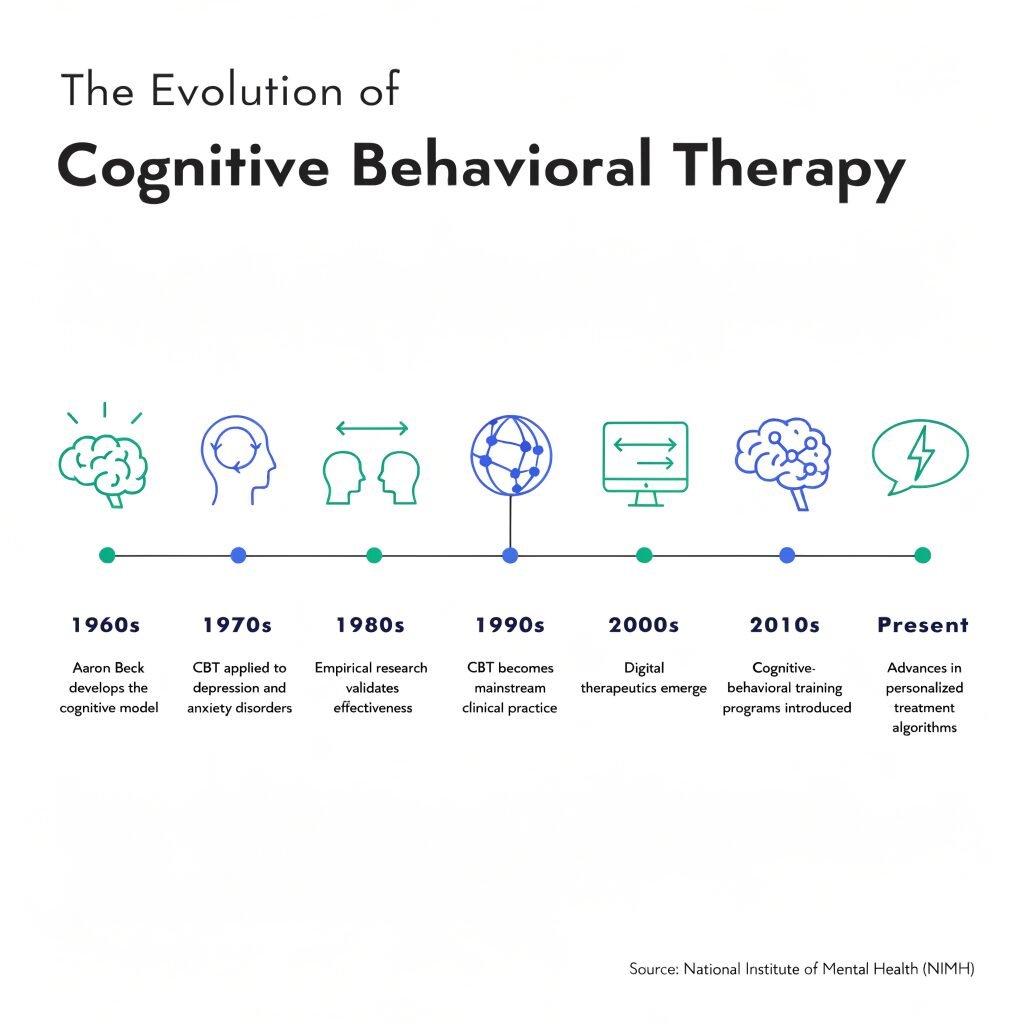
The cognitive model is the core theory behind CBT, explaining how our thoughts directly influence our emotions and behaviors. It was developed by Dr. Aaron Beck in the 1960s at the University of Pennsylvania and remains the foundation of modern cognitive behavioral therapy.
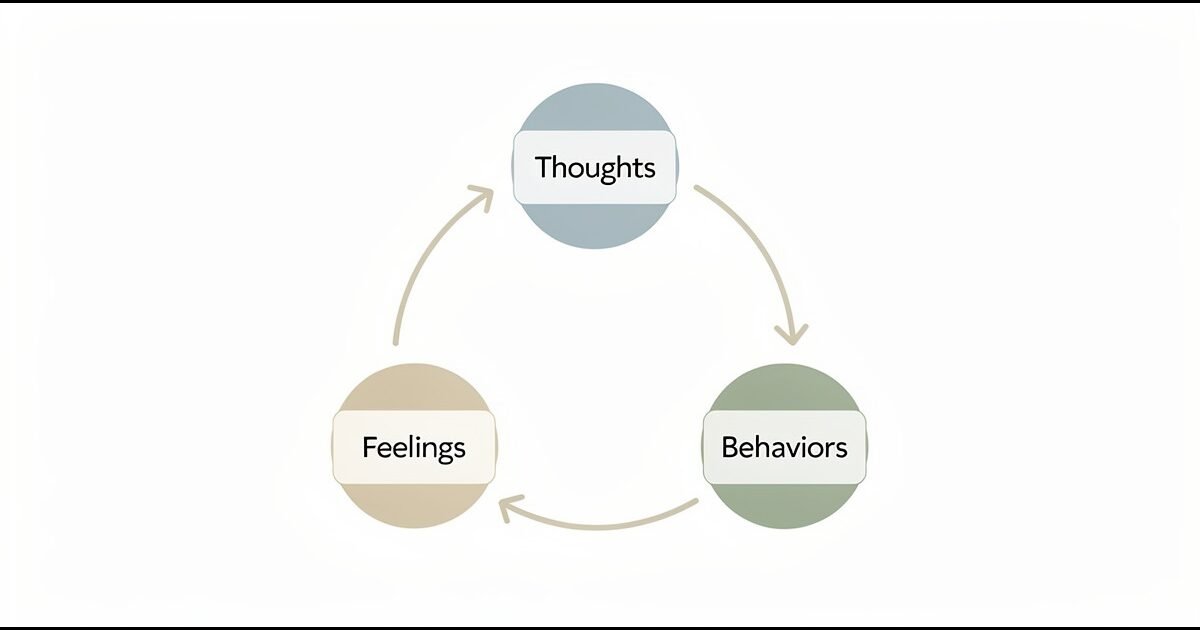
The cognitive model has three parts:
- Thoughts (cognitions) are the interpretations and beliefs we form about situations.
- Feelings (emotions) are our emotional responses, like anxiety, sadness, anger, or joy.
- Behaviors (actions) are what we do in response to our thoughts and feelings.
The key insight is powerful: when you change how you think, you can change how you feel and what you do. This isn’t about “positive thinking” or pretending everything is fine. It’s about developing realistic, balanced thinking that helps you navigate life more effectively.
According to the American Psychological Association, CBT is one of the most well-researched and effective forms of therapy available today, and the cognitive model is what makes it work.
The Core Idea: Thoughts Influence Everything
Imagine biting into a fresh, juicy lemon. Picture the sour taste hitting your tongue. Notice how your mouth starts to water. Your thought just created a real, physical response. That’s the power of cognition, and it’s the foundation of the cognitive model.
When we feel stuck or overwhelmed, it’s often not the situation itself causing the distress. It’s our interpretation of the situation. And that interpretation is something we can learn to recognize and adjust.
The CBT Thought Triangle: How Thoughts, Feelings & Behaviors Connect
The CBT triangle, also called the cognitive triangle, shows how thoughts, feelings, and behaviors influence each other in a continuous loop. Picture a triangle with one word at each corner: Thoughts, Feelings, and Behaviors. Arrows connect each corner to the other two.
The most important thing to understand about the cognitive triangle is this: you can break the cycle by changing any one corner. You don’t have to change everything at once. You just need to start with one piece.
The Thought Corner
Thoughts are the interpretations and beliefs we hold about situations. They can be rapid, automatic, and often happen outside our awareness. For example, if a friend doesn’t text you back, your thought might be: “She’s mad at me.” That thought then triggers a feeling, like anxiety or sadness.
The Feeling Corner
Emotions are the direct result of our interpretations, not the events themselves. The same event can produce completely different feelings depending on what you think about it. If you think “She’s mad at me,” you might feel anxious. If you think “She’s probably busy,” you might feel neutral or calm. The event is the same. The feeling is different.
The Behavior Corner
How we act is driven by our thoughts and feelings. When you feel anxious about a friend ignoring you, you might avoid texting again, send a follow-up message like “sorry if I bothered you,” or check your phone repeatedly. These behaviors can reinforce the original anxious thought, keeping the cycle going.
To learn more about how the cognitive model compares to other therapeutic approaches, see our DBT vs CBT: Which Therapy Is Right for You?.
The CBT Thought Cycle in Action
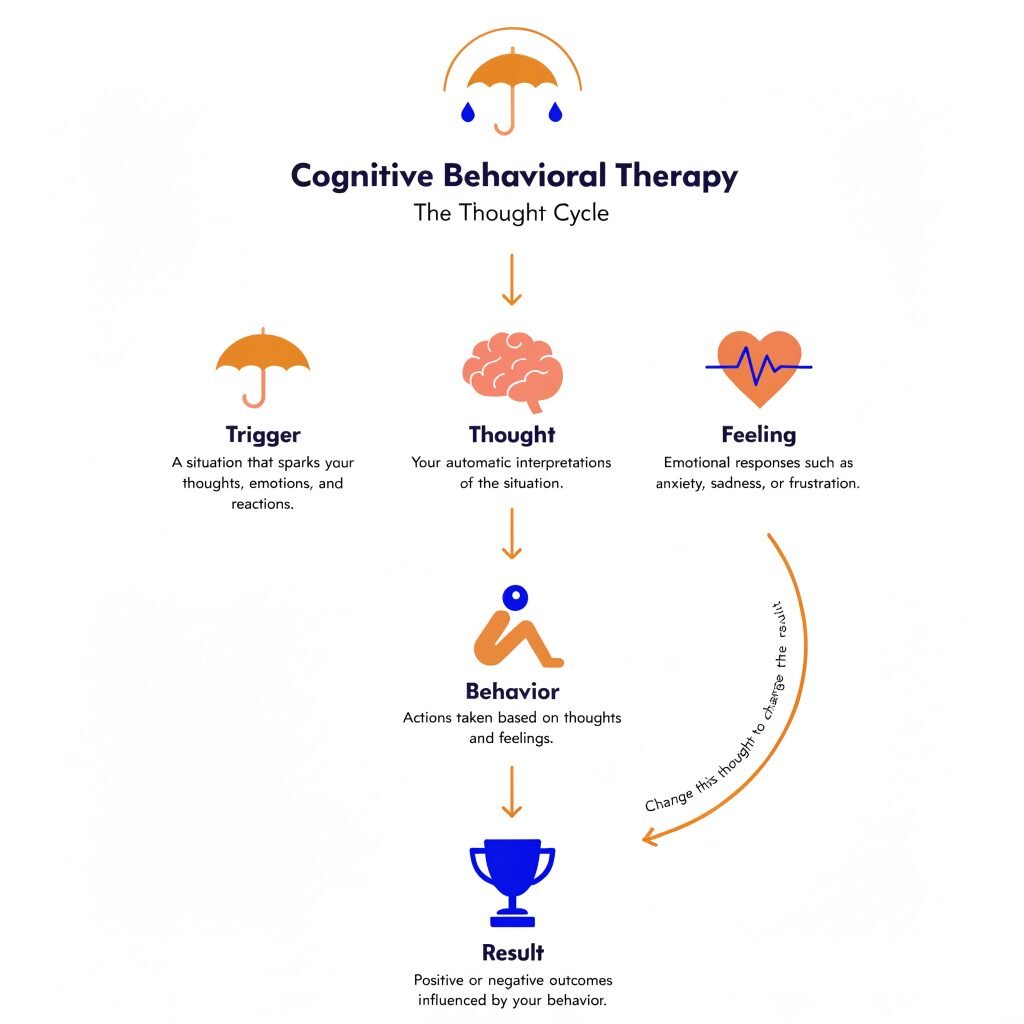
Let’s walk through a real-world scenario to see the cognitive model in action. This example uses something most people can relate to: a text left on read.
The Situation: You text a friend and they don’t reply for hours.
Path 1: The Unhelpful Cycle
- Thought: “They’re ignoring me. I must have said something wrong. They’re probably upset with me.”
- Feeling: Anxiety, hurt, worry.
- Behavior: You check your phone repeatedly or avoid texting again.
- Result: The anxiety persists, and you may withdraw from the friendship.
Path 2: The Balanced Alternative
- Alternative thought: “They’re probably busy. I know they have a lot going on right now.”
- Feeling: Neutral, calm, understanding.
- Behavior: You go about your day and text again later if needed.
- Result: The relationship stays healthy. No unnecessary distress.
Notice something important: the trigger is the same in both paths. The only thing that changed is the thought. That’s the cognitive model in action. When you change the thought, everything downstream changes too.
The Beck Institute, founded by Dr. Aaron Beck, describes CBT as therapy that helps people identify and change distorted thinking patterns to improve mood and behavior.
What Are Cognitive Distortions?
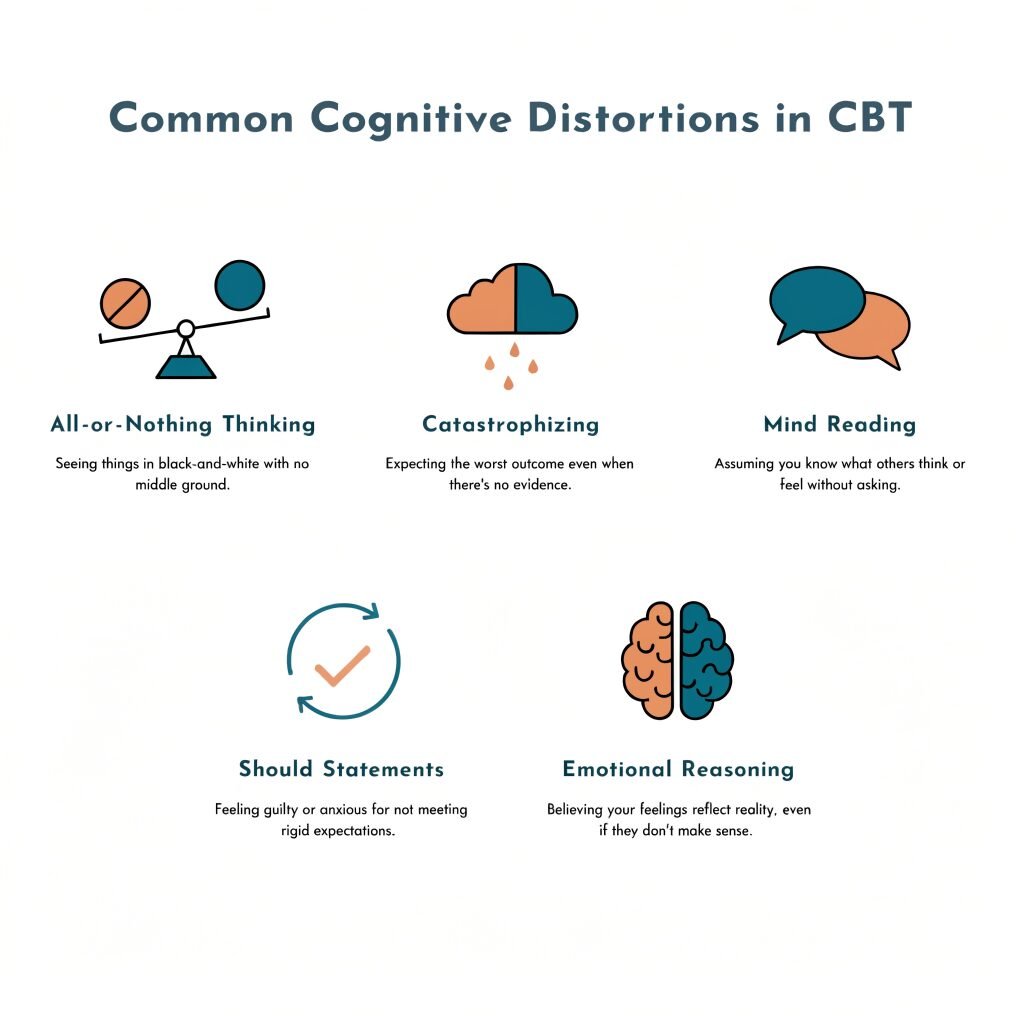
Cognitive distortions are the biased, unhelpful thinking patterns your brain falls into naturally, like mental shortcuts leading to the wrong conclusion. Everyone experiences them. They’re not a sign of weakness or a character flaw. They’re patterns, and patterns can be changed.
Here are five of the most common cognitive distortions:
- All-or-Nothing Thinking: Seeing things in black-and-white categories. Example: “If I don’t get an A on this exam, I’m a complete failure.”
- Catastrophizing: Assuming the worst-case scenario will happen. Example: “My boss wants to meet with me. I’m definitely getting fired.”
- Mind Reading: Assuming you know what others are thinking. Example: “She thinks I’m boring. I can tell by the way she looked at me.”
- Should Statements: Rigid rules about how things “should” be. Example: “I should be further along in my career by now.”
- Emotional Reasoning: Believing that because you feel something, it must be true. Example: “I feel anxious, so the presentation must be going badly.”
The NICE Guidelines recognize cognitive distortions as a key target in CBT treatment. Learning to spot these patterns is one of the most valuable skills you can develop.
Automatic Negative Thoughts (ANTs): How They Trip You Up
Automatic negative thoughts (ANTs) are the quick, uninvited thoughts that pop into your head throughout the day, often without you realizing it. They happen instantly, without conscious effort. They feel true in the moment, but they’re often distorted.
ANTs are not facts. They’re interpretations. And because they come from your own mind, they feel especially convincing.
Common Examples of ANTs
Common ANTs include thoughts like “I’m going to mess this up,” “Nobody likes me,” “I can’t handle this,” or “I always fail.” They feel true because your brain is wired for threat detection, a negativity bias that was useful for survival but often misfires in modern life.
The good news? Noticing ANTs is the first step to changing them. You can’t change what you don’t notice. According to National Institute of Health (NIH), CBT helps people become aware of these automatic thoughts and develop healthier alternatives.
Cognitive Restructuring: How CBT Helps You Challenge Unhelpful Thoughts
Cognitive restructuring is the process of identifying unhelpful thoughts, examining the evidence for and against them, and replacing them with more balanced, realistic alternatives. It’s the core skill you learn in CBT.
Importantly, cognitive restructuring is not about “positive thinking.” It’s about accurate thinking. The goal is to develop a more balanced perspective, not to pretend problems don’t exist.
The 4-Step Cognitive Restructuring Process
You can use this simple four-step process any time you notice a distressing thought:
- Catch the thought: Notice when you’re feeling distressed and identify the thought behind it. Ask yourself: “What am I thinking right now?”
- Check the evidence: Ask: “What’s the evidence for this thought? What’s the evidence against it?”
- Challenge the distortion: Identify which cognitive distortion is at play. Is it catastrophizing? Mind reading? All-or-nothing thinking?
- Create a balanced thought: Write a more realistic, helpful alternative that takes all the evidence into account.
Applied to our “text left on read” example:
- Thought: “They’re ignoring me. I did something wrong.”
- For: They haven’t replied in 4 hours.
- Against: They’ve been busy this week and never ignored me before.
- Balanced: “They’re probably busy. I’ll check in tomorrow.”
The goal is not to eliminate negative thoughts. It’s to build a more balanced, accurate perspective. The Cleveland Clinic describes cognitive restructuring as a fundamental component of effective CBT treatment.
Cognitive restructuring is one of many techniques used in CBT. Learn more about CBT at Abalance Counseling.
Common CBT Techniques You Might Try
CBT uses several practical techniques to help you apply the cognitive model. These are tools you can learn and use for life.
Thought Records
A thought record is the most fundamental CBT tool. You write down the situation, your automatic thought, the emotion you felt, and a balanced alternative. This highlights the direct connection between thoughts and feelings.
Behavioral Experiments
Behavioral experiments help you test your predictions against reality. If you think “If I speak up in the meeting, everyone will judge me,” try speaking up and see what happens. Often, the feared outcome doesn’t occur.
Behavioral Activation
Behavioral activation is used especially for depression. It involves scheduling small, positive activities to break the cycle of withdrawal and low mood. Even something small creates momentum.
Exposure Therapy
Exposure therapy involves gradually facing feared situations in a safe, controlled way. It’s commonly used for anxiety, phobias, and PTSD. You start with the least scary version and slowly work your way up.
While CBT focuses on thoughts and behaviors, Cognitive Processing Therapy (CPT) is a specialized approach designed specifically for trauma survivors.
How the Cognitive Model Applies to Anxiety, Depression & Trauma
The cognitive model isn’t just abstract theory. It maps directly to specific conditions, helping explain why certain thought patterns develop and how they can be addressed.
Anxiety and the Cognitive Model
In anxiety, the core thought pattern involves overestimating threat and underestimating your ability to cope. Common cognitive distortions include catastrophizing, mind reading, and fortune-telling. The cycle looks like this: anxious thought, physical symptoms, avoidance, short-term relief, and long-term anxiety.
CBT is especially effective for anxiety disorders. According to a NICE Guidelines, approximately 60% of people with anxiety see significant improvement. If you’re looking for support, explore anxiety treatment at Abalance.
Depression and the Cognitive Model
In depression, the core thought pattern involves a negative view of yourself, the world, and the future, a framework known as Beck’s cognitive triad. Common distortions include all-or-nothing thinking, should statements, and emotional reasoning. The cycle looks like this: negative thought, low mood, withdrawal, and more negative thoughts.
The NICE Guidelines state CBT can be as effective as medication for mild to moderate depression. Learn more about depression support at Abalance.
Trauma and the Cognitive Model
Trauma can create rigid, fear-based beliefs about safety, trust, and control. Cognitive Processing Therapy (CPT) is a CBT-based approach for trauma that focuses on identifying and challenging these beliefs. If you’ve experienced trauma, trauma-informed care at Abalance can help. The cognitive model explains WHY these patterns happen, which means they can be changed.
What to Expect in a CBT Session at Abalance Counseling
If you’ve never been to therapy before, it’s natural to wonder what happens in a session. CBT is structured, collaborative, and practical. Your therapist is a guide, not a lecturer.
Here’s what a typical session looks like:
- Check-in (5-10 minutes): How was your week? What thoughts or patterns came up?
- Set the agenda (2-5 minutes): What do you want to focus on today?
- Review practice (5-10 minutes): Discuss the thoughts or situations you noticed between sessions.
- Learn a new skill (15-20 minutes): Practice a CBT technique together, like a thought record or cognitive restructuring exercise.
- Plan for the week (5 minutes): What will you practice between sessions?
You don’t need everything figured out before your first session. Your therapist will meet you where you are.
Ready to try CBT? Learn more about our CBT services at Abalance Counseling and how we can help.

Key Takeaways
Understanding how CBT works through the cognitive model gives you a framework for real change. Here’s what to remember:
- Your thoughts shape your feelings and behaviors. That’s the cognitive model.
- The CBT triangle shows how thoughts, feelings, and behaviors are connected in a continuous loop.
- Cognitive distortions are common thinking traps. Learning to spot them is the first step to changing them.
- Cognitive restructuring helps you replace unhelpful thoughts with balanced, realistic ones.
- CBT techniques like thought records and behavioral experiments give you practical tools you can use for life.
Whether you’re struggling with anxiety, depression, or feel stuck in unhelpful thought patterns, understanding how CBT works is the first step. The next step is reaching out. Our team at Abalance Counseling is here to help you put the cognitive model to work in your life.
Schedule a consultation and take the first step toward feeling better.