If you have been through something traumatic and find yourself stuck in painful thoughts about it, you are not alone. Cognitive Processing Therapy (CPT) is a powerful, evidence-based way to move forward. Many people carry the weight of trauma long after the event has passed, and the thoughts that come with it can feel impossible to shake. These feelings are real, and they are valid.
There is a therapy designed specifically to help with this. Cognitive Processing Therapy (CPT) is a structured, evidence-based type of cognitive behavioral therapy that helps people heal from PTSD and trauma. It focuses on identifying and changing “stuck points,” unhelpful beliefs about the trauma that keep symptoms going. CPT is usually done in 12 sessions and has been shown to significantly reduce PTSD symptoms (APA, 2017).
In this guide, you will learn what CPT is, how it works, what happens during sessions, and whether it might be the right path for you.

What Is CPT (Cognitive Processing Therapy)?
Cognitive Processing Therapy is a specific form of cognitive behavioral therapy (CBT) developed in the late 1980s by Dr. Patricia Resick. Originally created to help survivors of sexual assault, research has since shown it is highly effective for anyone with PTSD, regardless of the cause (VA National Center for PTSD).
Unlike general talk therapy, CPT is structured and time-limited. You work through a specific curriculum over 12 sessions, with each session building on the one before. The focus is always on your thoughts and beliefs about the trauma, not just the events themselves. The VA and Department of Defense both recommend CPT as a first-line treatment for PTSD (VA/DoD Clinical Practice Guideline), and the American Psychological Association gives it a strong recommendation based on multiple randomized controlled trials (NIMH, PTSD Overview).
To learn more, visit our page on CPT services at Abalance Counseling.
How Does CPT Work?
The core idea behind CPT is simple but powerful: it is not the traumatic event itself that causes the most suffering. It is what you tell yourself about the event. The thoughts and beliefs you formed because of the trauma are what keep the pain alive.
In CPT, these unhelpful beliefs are called “stuck points.” A stuck point is a thought or belief about the trauma that feels true but actually keeps you stuck. For example, after a car accident you might believe “I will never be safe again.” After being betrayed, you might believe “I can never trust anyone.” These beliefs feel real, but they are not always accurate.
CPT helps you examine stuck points through worksheets, guided exercises, and conversations with your therapist. You learn to test your beliefs against the evidence. You do not ignore what happened. Instead, you find a way to think about it that is more balanced and less harmful to your daily life.
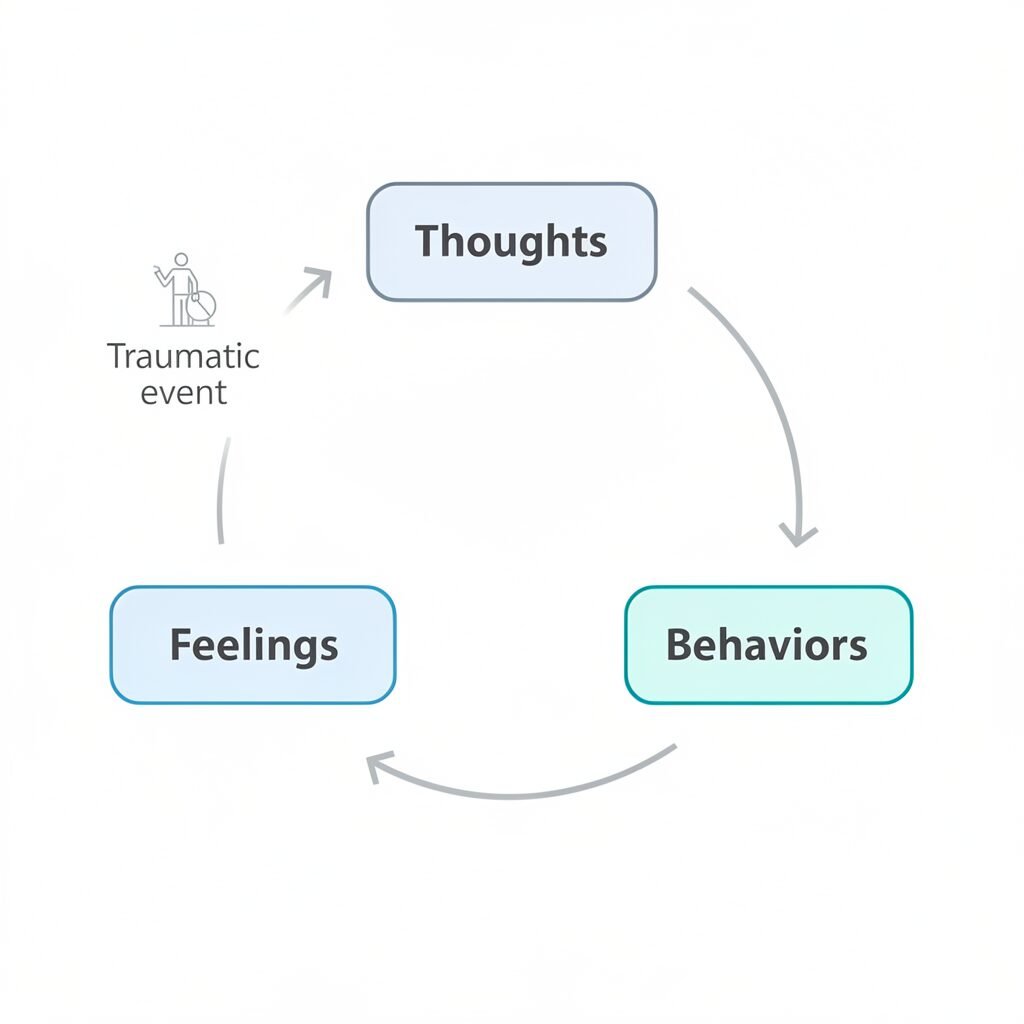
This is based on the cognitive triangle: thoughts, feelings, and behaviors are connected. A traumatic event shapes your thoughts, which influence how you feel, which drives what you do. CPT helps you break the cycle at the thinking level.
What Are Stuck Points?
Stuck points are at the heart of CPT. They are the beliefs about the trauma that keep PTSD symptoms going.
Examples of Stuck Points
Self-blame: “I should have seen it coming. It is my fault.” Many survivors carry guilt even when the event was outside their control.
Safety: “The world is dangerous. I am never safe.” After trauma, feeling on guard is natural, but constant danger feelings can prevent you from living fully.
Trust: “I cannot trust anyone.” When someone you relied on caused harm, struggling to trust others makes sense, but this belief can isolate you from people who care.
Power and control: “I have no control over my life.” Trauma can leave you feeling helpless, making it hard to take action or feel confident.
Self-esteem: “I am broken. I will never be the same.” Trauma can change how you see yourself, but this belief is not permanently true.
Intimacy: “I cannot let anyone get close to me.” When closeness has led to pain, pulling away makes sense, but it can prevent meaningful relationships.
The most important thing to know: stuck points are beliefs, not facts. They feel true, but they can be examined, questioned, and changed. That is exactly what CPT helps you do.
What Happens in a CPT Session?
Here is what to expect.
The First Few Sessions
In your first session, your therapist will teach you about PTSD and how CPT works. You will learn what stuck points are and start identifying your own. You will also write an “impact statement,” a letter about what the trauma means to you.
In sessions two and three, you will start learning to see the connection between events, thoughts, and feelings. Your therapist will give you a CPT workbook with worksheets you will use throughout.
The Middle Sessions
This is where the real work happens. You and your therapist will work through stuck points one by one using “ABC sheets” to track your thoughts and challenging questions to evaluate whether your beliefs are accurate. Each session focuses on a specific theme, and you practice between sessions.
The Final Sessions
In the last few sessions, you review your progress and consolidate the skills you have learned. The goal is for you to walk away with tools you can use for the rest of your life, not just during treatment. You can also read about what to expect from CPT on the VA website.
How Long Does CPT Take?
The standard CPT protocol is 12 sessions, usually held once per week. Each session lasts about 50 to 60 minutes, making it a short-term treatment compared to therapy that can go on for months or years.
Some people need fewer sessions (around 8 to 10), while others may need a few extra (16 or more) for more complex trauma. Your therapist will adjust the timeline to fit your needs.
CPT can be done in person or via telehealth. Research shows that CPT delivered through secure video sessions is just as effective as in-person therapy (APA, 2017). At Abalance Counseling, we offer CPT in-person at our Central Valley locations and via telehealth throughout California.
What Does CPT Help With?
The primary condition CPT treats is PTSD (posttraumatic stress disorder). It also helps with related issues that often accompany trauma: anxiety, depression, guilt, shame, and difficulty trusting others.
CPT is effective for trauma from many sources, including sexual assault, military combat, childhood abuse, car accidents, natural disasters, and violent events. Monson et al. (2006) found that 80 to 90 percent of veterans who completed CPT no longer met the diagnostic criteria for PTSD. Chard et al. (2012) showed similar results in civilian populations.
CPT is not the right fit for everyone. A qualified therapist will assess whether it is the best approach for you. If you are dealing with severe dissociation or active substance use, stabilization may come first. Learn more about our approach to trauma-informed care at Abalance Counseling.
CPT vs. Other Trauma Therapies
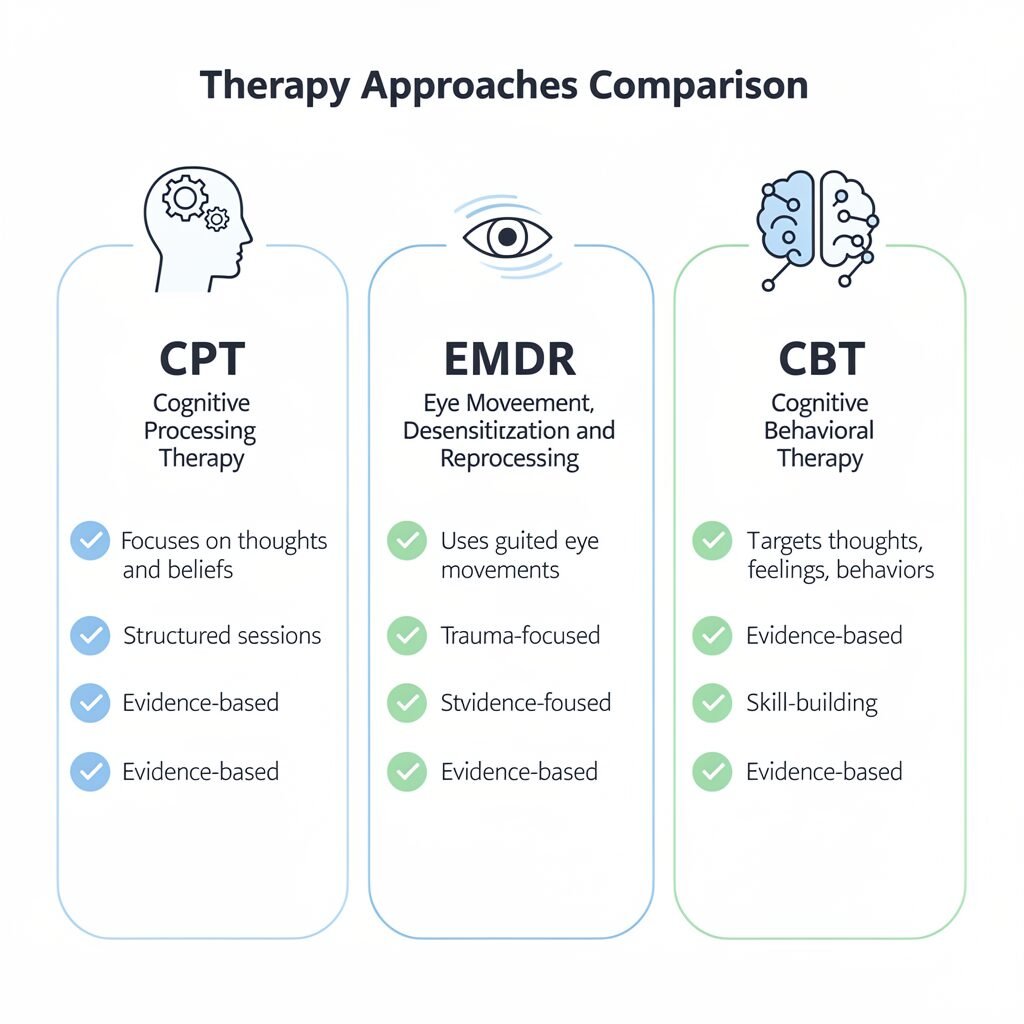
There are several evidence-based therapies for trauma. Here is how CPT compares to the most common options.
CPT vs. EMDR
EMDR (Eye Movement Desensitization and Reprocessing) uses bilateral stimulation, such as eye movements, to help your brain process traumatic memories. CPT focuses on changing the unhelpful thoughts and beliefs that developed after the trauma. In CPT, you write about and discuss the trauma directly, with structured worksheets and homework. In EMDR, there is less verbal processing and less structured homework. Both are backed by strong evidence and recommended by the VA and DoD. Neither is “better” overall. Our therapists at Abalance Counseling are trained in both and can help you decide which fits best.
CPT vs. CBT
CPT is a type of CBT. All CPT is CBT, but not all CBT is CPT. General CBT addresses a wide range of thoughts and behaviors, while CPT is specialized for PTSD and focuses specifically on stuck points related to trauma. Learn more in our complete guide to CBT.
CPT vs. TF-CBT
Trauma-Focused CBT (TF-CBT) is designed for children and adolescents. CPT is designed for adults. Both are evidence-based, but they are tailored to different age groups.
What Are the Benefits of CPT?
CPT has a strong track record of helping people recover from trauma. Here are the key benefits:
Reduces PTSD symptoms. Studies show 80 to 90 percent of people who complete CPT no longer meet PTSD diagnostic criteria (Resick et al., 2002; Monson et al., 2006; Resick et al., 2017).
Changes unhelpful thinking patterns. You learn to identify and challenge stuck points, and these skills stay with you long after therapy ends.
Short-term treatment. Most people complete CPT in 12 sessions, significantly shorter than many other forms of therapy.
Evidence-based. Supported by multiple randomized controlled trials and recommended by the APA, VA, and Department of Defense.
Builds lasting skills. The tools you learn continue to serve you whenever difficult thoughts arise.
Available via telehealth. Complete CPT from home through secure video sessions.
Covered by insurance. Most plans cover CPT as an evidence-based treatment. Abalance Counseling accepts a variety of plans and can help verify your coverage.

Is CPT Right for You?
If you are wondering whether CPT is the right fit, consider these questions:
Have you experienced a traumatic event that still affects you? Do you avoid reminders of what happened? Do you have negative beliefs about yourself, others, or the world because of the trauma? Are you willing to actively participate in therapy and complete practice between sessions? Are you ready to talk about the trauma in a structured way?
CPT works best for people who have clear memories of the trauma, are motivated to change, and can commit to weekly sessions. If you are in active crisis or dealing with severe dissociation, your therapist may recommend stabilization work first.
Only a qualified therapist can determine if CPT is right for you after a thorough assessment. If you are ready to take that step, schedule a consultation with our CPT-trained therapists at Abalance Counseling.
Frequently Asked Questions
What is the success rate of CPT?
Research shows 80 to 93 percent of people who complete CPT no longer meet the criteria for PTSD diagnosis. Resick et al. (2002) found significant reductions in PTSD symptoms compared to a control group, and Monson et al. (2006) found similar results with military veterans.
How is CPT different from regular talk therapy?
CPT is structured, time-limited, and focused specifically on changing stuck points related to trauma. Regular talk therapy may be less structured and might not directly target trauma-related beliefs.
Can CPT be done online?
Yes. Research shows CPT via telehealth is as effective as in-person therapy. Abalance Counseling offers CPT through secure video sessions throughout California. Learn more about our telehealth options.
Is CPT covered by insurance?
Most insurance plans cover CPT as an evidence-based treatment. Abalance Counseling accepts a variety of plans and can help verify your coverage.
How long does each CPT session last?
Each session is approximately 50 to 60 minutes. The standard protocol is 12 sessions, usually once per week.
Do I have to talk about the trauma in detail?
CPT involves writing about the trauma in an impact statement and discussing how it affected your beliefs. You do not have to go into graphic detail, but you do need to engage with the material. Your therapist will guide you at a safe pace.
What is the difference between CPT and CBT?
CPT is a specific form of CBT designed for PTSD and trauma. While CBT addresses a wide range of thoughts and behaviors, CPT focuses specifically on stuck points related to your trauma. See our complete guide to CBT.

Take the Next Step Toward Healing
Healing from trauma is not easy, but you do not have to do it alone. Cognitive Processing Therapy is one of the most well-researched and effective treatments for PTSD, designed to give you real, lasting skills you can carry with you for life. You deserve to feel safe, to trust again, and to move forward.
Ready to explore whether CPT could help you? Here is what you can do next:
Schedule your first appointment with a therapist who specializes in CPT.
Learn more about our CPT services and how they work at Abalance Counseling.
Ask about telehealth options if you prefer to start therapy from home.
You have already taken the first step by reading this guide. The next step is reaching out. We are here when you are ready.
This blog is educational and not a replacement for individualized mental health care. If you are in crisis, please call 911 or the National Suicide Prevention Lifeline at 988.
Published: August 12, 2026 | Last Updated: August 12, 2026 | Reviewed by Victoria Carrera, LCSW